

Studying with Disabilities
Removing barriers. Enabling access.
For our students
Removing barriers. Enabling access. To ensure you can focus fully on your studies, we want to provide you with the best possible support. We offer support for physical disabilities and chronic illnesses, as well as for conditions related to neurodevelopmental disorders (such as ADHD, dyslexia or autism) and mental health conditions.
For personalised advice on planning your course of study, please contact the academic counseling service for your degree programme directly. It may also be helpful to speak to the programme coordinators for your degree programme.
For our employees
Dear colleagues, here you will also find an initial overview of the services offered by the HHN. Please note that the Schwerbehindertenvertretung serves as a dedicated point of contact for all staff members.
Important information and offers
Up to 5% of the available study places in a degree program are allocated each semester through the so-called hardship quota (“Härtefallquote”). A prerequisite is that applicants with disabilities meet the general admission requirements of Heilbronn University.
The hardship provision allows applicants to assert special personal or health-related circumstances that may lead to disadvantages in the regular application process.
In accordance with the Admission and Enrollment Regulations of Heilbronn University, an informal written statement must be submitted as part of the application. This statement must describe the personal situation and provide a detailed explanation of why waiting semesters are unreasonable. Supporting documents (e.g. medical certificates) must be enclosed.
Please select the corresponding option for a hardship application in the online application portal. Upload both your statement and all required supporting documents in the upload section before finally submitting your application.
If you have any questions regarding admission, please contact Melanie Dominke from the Academic Affairs Office.
We recommend visiting the respective campus in advance and obtaining information about accessible facilities. If you are interested, please contact us by email at inklusiv-studieren@hs-heilbronn.de.
Under certain circumstances, students may be exempt from tuition fees charged to international students and students enrolled in a second degree programme.
If students with disabilities face a disadvantage during an examination, this can be individually compensated for through what is known as ‘disadvantage compensation’. We recommend seeking individual advice on this matter in advance from our representatives on the relevant campus. Such a consultation is mandatory for the permanent granting of disadvantage compensation. Disadvantage compensation, once granted, serves to offset individual limitations and is not shown on the transcript.
- Submit your application for compensation for disadvantages as early as possible, ideally immediately after re-registering for the next semester. For organisational reasons, the application must be submitted by the end of the registration period for examinations at the latest.
- Please complete the form electronically using Adobe Acrobat Reader, sign it digitally and forward it together with the relevant supporting documents.
- If your disability prevents you from studying full-time, Heilbronn University offers a tailored part-time study programme.
“If a candidate can demonstrate that, due to a disability or chronic illness, they are unable to sit preliminary or final examinations, in whole or in part, in the prescribed form, the chair of the relevant examination board shall permit them to sit the examinations within an extended time limit or to undertake equivalent examinations in an alternative format. It must be ensured that the competencies to be demonstrated in the examination are also demonstrated through this alternative form. To this end, the submission of a medical certificate may be required.”
HHN has two mobile sound amplification systems (Roger by Phonak) at the TechCampus Sontheim & Bildungscampus. If required, please contact:
Bildungscampus
TechCampus Sontheim
Campus Künzelsau

Some foundations have made it their specific aim to support students with disabilities. You can find an overview here.
Zielgruppe
Studierende mit chronischen Erkrankungen, u.a.:
- Mukoviszidose
- entzündliche Darmerkrankungen (v.a. Morbus Crohn)
- Rheumatoide Arthritis
- Multiple Sklerose
Voraussetzungen
Angesprochen werden Studierende, die trotz ihrer chronischen Erkrankung eine hohe Leistungsbereitschaft zeigen und ihren Lebensweg gehen mit dem Motto "auf keinen Fall aufgeben!"
Unterstützung
Es werden jährlich bis zu 5 Stipendien vergeben mit einer monatlichen Unterstützung in Höhe von 500 Euro. Die Zusage wird zunächst für ein Jahr erteilt, eine Wiederbewerbung ist möglich.
Zusätzlich erhält jeder Stipendiat/jede Stipendiatin einen luftsprung-Mentor und wird bei der Berufswahl und Arbeitsplatzsuche unterstützt.
Bewerbung
Die vollständigen Bewerbungsunterlagen werden per Mail an stipendium@aktion-luftsprung.de gesendet.
Eine Bewerbung ist jeweils bis zum 15. April des laufenden Jahres möglich.
Bewerbungsunterlagen
Folgende Unterlagen sind für die Bewerbung bei luftsprung campus erforderlich:
- Lebenslauf
- Zeugnisse
- Ärztliche Bescheinigung über die Erkrankung mit Empfehlungsschreiben des Arztes
- Nachweis der finanziellen Situation (detaillierte Aufstellung der aktuellen Einkünfte- und Unterstützungsleistungen) / Auskunft über BAFÖG Mittel oder andere von Dritten gewährte Leistungen
- Motivationsschreiben in dem auf folgenden Punkte eingegangen werden soll: familiärer Hintergrund, Leben mit der chronischen Erkrankung (Compliance, Adhärenz), Meistern von Lebenssituationen, aus Schwächen Stärken machen, Talente und Leidenschaften, gesellschaftliches Engagement, Bereitschaft zu zukünftigem Engagement für aktion luftsprung, Ausbildungsziel. Für dieses Dokument gibt es keine Formvorschriften. Es soll gezeigt werden, wie das Leben der Bewerber so verläuft! Auch gerne als Video, Zeichnung, Fotostory oder…
Weitere Informationen
https://aktion-luftsprung.de/luftsprung-campus/stipendium-bewerbung/
Die Stiftung
Gründer der 2006 gegründeten Gemeinnützigen Stiftung sind der blinde Journalist Keyvan Dahesch und seine Frau Annie.
Zweck der Stiftung
Stiftungszweck ist die Förderung und Unterstützung von Personen, die infolge ihres körperlichen, geistigen oder seelischen Zustandes auf die Hilfe anderer angewiesen sind sowie die Unterstützung von bedürftigen Menschen.
Förderung
- Unterstützung von körperlich, geistig oder seelisch behinderten Mitbürgern durch Finanz- oder Sachzuwendungen im Sinne einer Hilfe zur Selbsthilfe
- Finanzierung von Hilfsmitteln oder baulichen Veränderungen an Wohnungen und Einrichtungen zur Erleichterung des Alltagslebens
- Finanzierung von geeigneten Beförderungsmitteln oder deren behindertengerechter Umbau für höhere Mobilität
- Finanzierung oder Durchführung von schulischen oder beruflichen Aus- und Fortbildungsmaßnahmen, Förderung von Publikationen, die auf Situation von schwerstbehinderten Menschen aufmerksam machen
Weitere Informationen
Weitere Informationen zur Stiftung und den Bewerbungsformalitäten können hier nachgelesen werden.
Die Stiftung
Die Stiftung wurde 2011 von Frau Elfriede Breitsameter gegründet, die selbst an Poliomyelitis erkrankt ist.
Zweck der Stiftung
Der Stiftungszweck in Form einer finanziellen Unterstützung soll vornehmlich den Menschen zugutekommen, die an Poliomyelitis oder auch an multipler Sklerose erkrankt sind.
Dabei soll in erste Linie wirklich bedürftigen Personen geholfen werden, also denen, die keinerlei Gelder von Staat oder Krankenkasse aufgrund ihrer Erkrankung erhalten, um durch geeignete Maßnahmen ihr Leben etwas zu erleichtern.
Förderung
Stellung und Finanzierung von Pflegepersonal, Medikamenten, Hilfsmitteln (z.B. Rollstuhl) u.ä.
kurzfristige und unbürokratische dringend benötigte Unterstützung
Weitere Informationen
Weitere Informationen zur Stiftung und der Beantragung unter http://www.breitsameter-stiftung.de/.
Die Stiftung
Google will die zukünftigen Wegbereiter darin unterstützen, das Beste aus ihrem Talent zu machen - hierfür stellen sie Stipendien für Studierende mit Handicap im Bereich Computer Science zur Verfügung.
Zweck der Stiftung
Unterstützt werden Studierende mit Handicap in den Bereichen Computer Science, Computer Engineering, Informatik oder ähnliche technische Bereiche.
Förderung
Die Förderung umfasst ein Stipendien in Höhe von 7.000 € für ein akademisches Jahr. Förderkriterien sind akademischer Hintergrund, Führungseigenschaften und Leidenschaft für Computer Science.
Weitere Informationen
Weitere Informationen zum Stipendium und zur Bewerbung unter http://www.google.com/studentswithdisabilities-europe/.
Die Stiftung
Nathalie Todenhöfer, selbst an Multipler Sklerose erkrankt, gründete die Stiftung, um MS-Kranken in Not etwas Lebensfreude zu schenken.
Zweck der Stiftung
Unterstützung von Menschen mit Multipler Sklerose und solcher, die durch die Krankheit in eine Notlage gekommen sind.
Förderung
- behindertengerechter Umbau von Wohnungen
- Hilfe bei der Betreuung von Schwerstkranken
- Erholungsurlaube
- Erfüllung kleiner Lebensträume
Weitere Informationen
Weitere Informationen zu Nathalie Todenhöfer und der Stiftung unter http://www.nathalie-todenhoefer-stiftung.de/.
Die Stiftung
Die Stiftung hat ihren Sitz in Berlin und wurde zum Zweck der Blindenfürsorge gegründet.
Zweck der Stiftung
Die Paul und Charlotte Kniese Stiftung bietet blinden und sehbehinderten Studierenden finanzielle Hilfe in Notfällen an.
Förderung
Förderhöhe und -dauer richten sich nach den persönlichen Umständen der Studierenden.
Weitere Informationen
Es kann direkt Kontakt mit der Stiftung aufgenommen werden:
Hardenbergplatz 2, 10623 Berlin
Telefon: 030 795 92 30
Die Stiftung
Die gemeinnützige und mildtätige Stiftung wurde gegründet als Reaktion auf die immer häufiger auftretenden Chronisch Entzündlichen Darmerkrankungen (CED).
Zweck der Stiftung
Zweck der Stiftung ist die Unterstützung von Menschen mit chronisch entzündlichen und anderen schwerwiegenden Darmerkrankungen sowie die Förderung von Wissenschaft und Forschung zur Diagnose und Behandlung solcher Erkrankungen.
Förderung
- Gewährleistung von Stipendien zugunsten von Menschen, die aufgrund ihrer Erkrankung in ihrer schulischen und/oder beruflichen Aus- und Weiterbildung eingeschränkt sind. Dazu gehören u.a. akademische Ausbildung an einer Fachhochschule oder um eine Weiterbildug an einer Fachschule.
- Finanzierung krankheitsbedingter Mehrausgaben
- Ausgleich von Ausbildungsverzögerungen
- Förderung sonstiger ausbildungsrelevanter Vorhaben, die ohne zusätzliche Unterstützung nicht umgesetzt werden könnten, wie Auslandsaufenthalte oder wohnortfremde Ausbildung
- in Ausnahmefällen ist die Unterstützung zum Lebensunterhalt möglich, etwa zur Examensvorbereitung nach langer Krankheitsphase
Weitere Informationen
Weitere Informationen zur Stiftung und der Förderung unter http://www.stiftung-darmerkrankungen.de/home/.

Accessible parking spaces are located directly in front of Building A (main entrance), accessible via Max-Planck-Straße.

Accessible parking spaces are located in front of Building G in the inner courtyard. Access is via Robert-Bosch-Straße and the barrier at the staff car park.
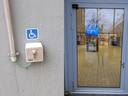
In addition to the two main entrance doors, there is an automatic door that can be opened from the outside with a Euro key. There is a button inside for opening the door.
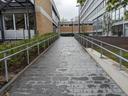
The ramp provides barrier-free access to the ticket machines and the parent-child room in Building A.
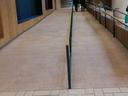
The ramp provides barrier-free access to the AStA office and to buildings E/F.
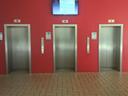
All floors are accessible via the lifts.
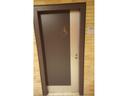
The accessible toilet is located in A118/119 and is equipped with a Euro lock.
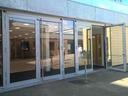
Access to the canteen, cafeteria and assembly hall is possible from the inner courtyard.

Access to the auditorium and the offices of the Academic Department and Central Student Advisory Service via the lift.
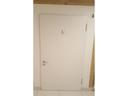
The accessible toilet in the basement is equipped with a Euro lock.
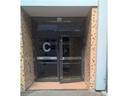
The building can be accessed via the inner courtyard. The door opens automatically.
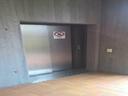
All levels are accessible via the lift.
The ramp provides barrier-free access to Building D.

The automatic door provides access to Building D.

Lecture hall D002 has two wheelchair spaces.
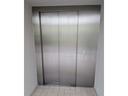
All floors can be reached via the lift in Building D.

The student lounge in room D 010 offers wheelchair-accessible workstations. Access is possible at ground level or via the lift.
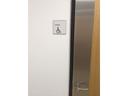
The accessible toilet is in room D 007 B.
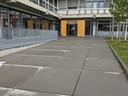
The ramp provides barrier-free access to Building E.
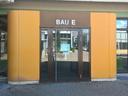
Access to the library via the entrance door. An automatic door opener is available.
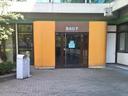
Entrance to Building F via the inner courtyard.
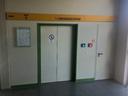
All levels can be reached via the lift between buildings E and F.
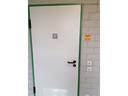
The accessible toilet is located in room F 058.
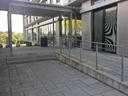
Barrier-free access to Building G via the ramp. The door opens automatically.
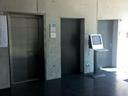
Lift and accessible toilet with Euro lock on the ground floor.

3 accessible parking spaces for students in the East car park.

3 accessible parking spaces for employees and guests in the West car park.

Barrier-free access to Building M – Cafeteria
Access to the canteen at the Bildungscampus; the catering area can be reached via the lift.
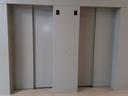
All levels are accessible via the lifts.
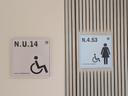
The accessible toilets are located in N.U.14 and N.4.53.
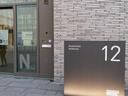
Entrance door to Building N with electric door opener.
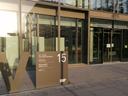
Access to the LIV library with automatic door opening.
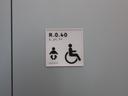
The accessible toilet is located in R.0.40.
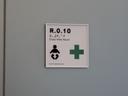
First aid room with baby changing facilities.
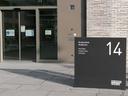
Barrier-free entrance to Building S with automatic door opening.
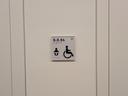
The accessible toilet with baby changing facilities is located in S.0.54. Another accessible toilet with baby changing facilities is located in S.3.55.
Entrance to Building T with automatic door opening.
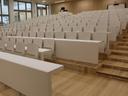
The T.V.50 lecture theatre has two wheelchair-accessible workstations in the front row. A barrier-free toilet is located in room T.V.10. Another barrier-free toilet is located in room T.3.64.

Barrier-free access via the side entrance to Building A with ramp.

Entrance to Building D from the car park.

Access to Building E with door opener.
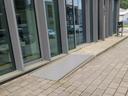
Barrier-free access to Building F via the ramp.
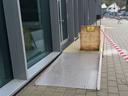
Barrier-free access to Building G via the ramp.
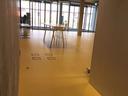
Barrier-free access to the main lecture hall in Building G.
Accessible toilets can be found as follows:
- Building C, rooms 003 and 102
- Building D, room 016
- Building E, room 005
- Building F, room 016
- Building G, foyer on the ground floor
Baby changing facilities are available in room C 018.
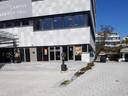
The main entrance is accessible via the ramp.
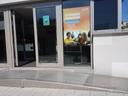
The AStA office is accessible via the ramp.

The accessible toilet is located in Building A, Room 007.
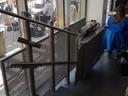
There is a stair lift in the canteen.
First point of contact
Please book an appointment by email.
Representative for students with disabilities
The representatives for students with disabilities will support and advise you on options such as compensation for disadvantages or extension of study time. The representatives are responsible for any form of impairment, regardless of whether physical, mental or other limitations make your studies more difficult.
Please also contact your lecturers at an early stage and inform them if you need support during lectures. This could be the use of a mobile signal transmission system, sign language interpreters, etc.
TechCampus
Bildungscampus
Schwäbisch Hall Campus
Künzelsau Campus
Further information and offers
With its counselling service for students with disabilities and chronic illnesses, Deutsches Studierendenwerk offers an extensive online library for research on various topics.
Inclusion and diversity are key themes of the 2021–2027 generation of the Erasmus+ programme. Through a range of targeted measures, the programme helps to promote greater equality of opportunity.
For further information, please contact Jutta Krieger.
This guide provides precise definitions of almost all study-related terms, as well as further information such as useful links and contact details! From A for ‘semester abroad’ to L for ‘study skills’ and Z for ‘transcript’
- Tips for your inclusive Career: On the job platform myAbility.jobs, experts answer questions in the Career Guide on topics such as job searching, interviews, application documents, chronic illness, or neurodivergence. These tips are based on many years of experience in advusubg both job seekers and employers.
- Find Inclusice Employers: On myAbility.jobs, people can find job opportunities in the open labor market. Companies and orgaizations that advertise psitions on myAbility.jobs value diversity and inclusion. The are open to accomotdating the individual accessibility needs of applicants. Take a look and apply directly to thes employers.
- Accessible Career Development Program: Every spring, the www.myAbilityTalent.org offers professional coaching and direct networking opportunities with inclusice employers that view diversity as a strength.
