



Capabilities & Equipment
Here’s what we can do—and here’s what we have to makeit happen
Filtration Simulation & Measurement
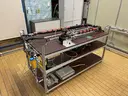
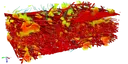
How can particle transport and separation in filters be modeled and simulated? We perform CFD simulations, analyze the filter structure using our microCT scanner, and validate our simulation results on various particle test benches that we designed and built ourselves.
Examples of research areas:
- Oil mist filtration
- Cabin air filtration
- Masks
Understanding and improving indoor air quality
How can we achieve healthy indoor air quality through ventilation and filtration while maintaining good thermal comfort and minimizing energy consumption? We conduct indoor measurements, perform flow simulations, and develop real-time computational models!
Analysis of Emissions and Immissions
How can vehicle emissions be quantified under real-world driving conditions using PEMS (Portable Emissions
Measurement System), taking into account driving dynamics, vehicle type, and the condition of the exhaust aftertreatment system?
Possible measurements:
- PN Particle number from 23 or 10 nm
- NO, NO2, NOx
- CO
- CO2 correlated with fuel consumption
Physical-mathematical modeling and simulation
How can complex physical systems be represented as mathematical problems that can be easily solved and simulated
using efficient solvers?
- Material models (Newtonian, linearly elastic, viscoelastic, ...)
- Methods for complex variables
- Discretization methods (FD, FE, spectral methods)
- Dimension reduction
- Multiphysics problems
Outlook: Further development of these methods, particularly with regard to numerical methods involving complex numbers
First integrals and potential methods
How can one use auxiliary quantities (potentials) to endow the equations of motion with mathematically desirable properties, such as integrability, and derive simplified equations from them?
- Transient flows
- Hydrodynamic Stability
- Simplified implementation using curvilinear coordinates
Perspective: Reduction of fluid dynamics problems to matrix algebras
Multiphase flow in porous media
How do two immiscible phases move through a porous medium under the influence of capillary, pressure, and
gravitational forces? We investigate these highly complex flow phenomena using modeling and numerical simulation, taking into account transport processes and non-isothermal conditions.
Variational methods
How can one find variational formulations as an alternative to the equations of motion in fluid dynamics, in order to build highly efficient simulation methods based on them?
- Universal Symmetries and Noether’s Theorem
- Analogy between Fluid Dynamics and Quantum Theory
- Incorporation of thermodynamics and dissipation
- Nonlinear acoustics
Outlook: Novel finite element methods


