
Disseration Guidelines & FAQs
This page provides an overview of the key information and guidelines for students completing their final theses under the supervision of Carolin Neffe. It covers the main expectations, requirements, and practical aspects of the thesis process. You will also find answers to frequently asked questions (FAQs) to help you prepare and navigate your thesis successfully.
Supervision and Collaboration
Meetings are available on request at the Bildungscampus or online; brief spontaneous telephone calls may also be possible. There are no fixed office hours and no mandatory supervision meetings. Students should prepare a clear agenda, specific questions and any necessary documents in advance.
Responsibility: Supervision helps refine the research question, approach and argument. Responsibility for planning, decisions, execution and writing remains with the student.
Most important: Ask questions whenever you need assistance!
The Exposé as a Basis for Supervision
At the beginning of the supervision process, students are asked to prepare a short exposé. It serves as a shared point of reference and allows the supervisor to quickly revisit the topic before meetings. The exposé is not graded.
The exposé should include:
- Working title and problem statement
- Preliminary research question, objectives and - where applicable - hypotheses
- Brief overview of the current state of research
- Planned methodology and data basis
- Preliminary structure
- Initial selection of key academic literature
- A provisional timeline, if useful (optional)
Academic Writing and Research
Use of Scientific Literature
- Use peer-reviewed academic literature as the core evidence base; retain seminal older publications where theoretically essential.
- As a general orientation, prioritise relevant journal articles from approximately the last ten years.
- Where possible, prioritise journals rated A+, A or B in the current VHB Publication Media Rating. Relevant lower-ranked or unranked work may also be used when quality and fit are carefully assessed.
- Do not merely summarise sources. Compare, evaluate and synthesise them into a coherent argument.
- Cite definitions, models, data, claims and adopted ideas completely and accurately.
Examples of relevant journals
Depending on the topic, relevant outlets include Academy of Management Journal, Academy of Management Review, Administrative Science Quarterly, Management Science, Organization Science, Strategic Management Journal, Journal of Business Venturing, Entrepreneurship Theory and Practice, Strategic Entrepreneurship Journal, Research Policy, Journal of Product Innovation Management, Journal of Management, Journal of Management Studies, Organization Studies, Organizational Research Methods, Journal of Organizational Behavior, The Leadership Quarterly, Journal of the Academy of Marketing Science, Journal of Marketing, Journal of Marketing Research, Marketing Science and Journal of Business Ethics. This list is illustrative; students must verify the current rating and topical fit.
Guidelines for Conducting Scientific Work
- Define key concepts and use them consistently.
- Align the research question, theoretical framework, methodology, results and conclusions.
- Explain methodological decisions and document the analysis transparently.
- Distinguish clearly between facts, interpretations and personal judgements.
- Use figures and tables selectively; label them, discuss them in the text and provide sources.
- Before submission, check content, language, references, lists, appendices and formal consistency.
Discussion and Critical Reflection
The discussion interprets the findings rather than merely repeating them. It should return to the research question and:
- compare findings with prior research and explain agreements or contradictions;
- derive theoretical and practical implications;
- consider plausible alternative explanations;
- address limitations relating to data, method, sample and transferability;
- develop well-supported recommendations for research and practice.
Critical reflection demonstrates academic judgement by distinguishing between conclusions supported by the evidence, conclusions that remain tentative, and conditions under which the findings might differ.
Structuring Your Paragraph
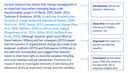
Paragraphs should be structured in accordance with established academic writing standards:
Assessment of the Thesis and Research Project
Assessment follows the applicable regulations of Heilbronn University. Separate assessment rubrics are available for Bachelor's and Master's theses and can be provided on request. The principal quality dimensions normally include:
| Dimension | What is expected |
|---|---|
Research problem | Relevance, clear objectives and a precise research question |
Theory and literature | Quality, breadth, recency, synthesis and critical use |
Methodology | Fit with the question, justification, transparency and rigorous execution |
Analysis and findings | Traceability, depth, accurate presentation and relation to the question |
Discussion | Interpretation, positioning, implications and critical reflection |
Argument and structure | Coherent reasoning, paragraph structure and appropriate weighting |
Academic rigour | Referencing, sources, language, formal consistency and independence |
Working process | Preparation, reliability and demonstrably independent work |
Submission Checklist
Before submitting your thesis, please take a moment to go through the checklist below carefully and make sure that all requirements have been met. This final check will help ensure that your thesis is complete, correctly formatted, and ready for submission.
- The research question is answered and conclusions are supported by the findings
- The argument is coherent and paragraph structure is clear
- The literature base is robust, relevant and correctly cited
- The methodology and analysis are transparently documented
- The discussion covers interpretation, limitations and implications
- Tables, figures, appendices and cross-references are complete
- AI use is disclosed under current Heilbronn University rules
- Language, formatting, lists and submission requirements are checked
