
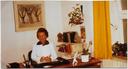
Liselotte Baum (1922–2015)
Director of Pharmacy. Lecturer. Pioneer.
Key Milestones
1922

Ölberg in Nierstein
Childhood
Liselotte Baum was born on 25 June 1922 in Selzen near Mainz, the eldest of three children in a wine-growing family from Nierstein. Through her mother, Liselotte Baum was related to the Cantzler family, whose history had been shaped by Protestant clergymen in the Palatinate for over 14 generations.
When Liselotte was six years old, her grandmother passed away, and she moved in with her grandfather, Dean Karl Cantzler – co-builder of the Memorial Church in Speyer – as the eldest grandchild, to offer support. During their walks together, her grandfather introduced her to the natural world and shared his extensive knowledge of plants and trees. Even in childhood, two qualities emerged that would stay with her throughout her life: a deep affinity with nature, and a willingness to take on responsibility early and act independently.
1940
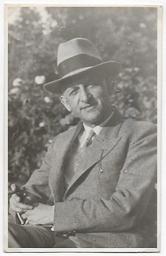
Hermann van der Floe, Liselotte Baum's master trainer
Source: Private collection
Education and Training
Between 1932 and 1938, Liselotte Baum attended the Oberrealschule in Oppenheim am Rhein and the Mädchen-Oberschule in Mainz, where she sat her Abitur in 1940.
From 1941 to 1946, Liselotte Baum undertook a placement at the Luisen-Apotheke pharmacy in Mannheim.
After passing her pharmaceutical preliminary examination in Karlsruhe, she was assigned by compulsory service to her training pharmacy. Her training years fell in the midst of the Second World War, and she witnessed traumatic events, including the destruction of the Luisen-Apotheke, in which her master trainer van der Floe also lost his life.
After the war, she continued her pharmaceutical training. In 1949, she sat her state examination at the Johann Wolfgang Goethe University in Frankfurt am Main and received her licence to practise as a pharmacist in the same year.
Her training years were shaped not only by the war, but also by National Socialist policies on women and education. While women were initially disadvantaged in accessing higher education, they were increasingly deployed in pharmaceutical roles with the onset of the Second World War. Liselotte Baum's compulsory service is a telling example of the growing role women were required to play in professional life during the war.
1950
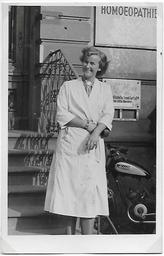
The young pharmacist Liselotte Baum, around 1955 in Frankfurt am Main
Source: Private collection
Career Stations
After beginning her career at the Adler-Apotheke in Offenbach am Main, her path led her first to Zurich in 1950. In the years that followed, she gained further professional experience in various cities and institutions, continuously broadening her pharmaceutical expertise.
In 1957, she achieved a truly decisive career milestone: she prevailed over numerous male applicants and was appointed Deputy Chief Pharmacist at the Städtische Krankenanstalten Heilbronn (Heilbronn Municipal Hospital).
She took up this post on 1 January 1958.
Just how significant this achievement was to her can be seen in her own words. We are fortunate that she recorded her experiences in a contribution to the book "Erwin Fuchs – Leben und Wirken eines aufrechten Heilbronners" (Erwin Fuchs – The Life and Work of an Upright Heilbronner):
"I was given to understand that I need not bother applying, as the post was intended for a man and a family breadwinner. This remark from the head of personnel did not deter me, and since I had made it onto the shortlist from among 24 applicants, I appeared before the Lord Mayor and the hospital committee at the appointed time. In the end, I was elected unanimously." – Liselotte Baum (2008)
This quote illustrates vividly the prejudices Liselotte Baum faced at the time – but equally, the determination with which she pursued her professional path.
1967
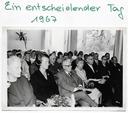
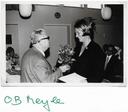
Appointment of Liselotte Baum as Chief Pharmacist, 1967
Source: Private collection
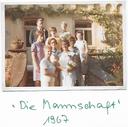
Liselotte Baum (front row, right) with her colleagues, 1967
Source: Private collection
Appointment as Chief Pharmacist
In 1967, Liselotte Baum was appointed Chief Pharmacist.
In this role, she headed a department of nine members of staff, who together were responsible for the pharmaceutical care of up to 1,000 patients.
1978
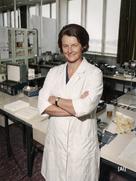
AI portrait: Gesine Born
The AI portrait depicts Liselotte Baum as a lecturer in the field of Medical Informatics at what was then the Fachhochschule Heilbronn.
Lectureship at the Fachhochschule Heilbronn
From 1978, Liselotte Baum took on a lectureship in Medical Informatics at what was then the Heilbronn Fachhochschule, now Heilbronn University of Applied Sciences.
The joint degree programme in Medical Informatics offered by Heilbronn University of Applied Sciences and the University of Heidelberg has existed since the winter semester of 1972/73. The establishment of the world's first degree programme in Medical Informatics in Heilbronn marked an important milestone in bringing together medicine and computer science. The creation of this programme laid the foundations for the emergence of a new interdisciplinary field and underscored Heilbronn's pioneering role in academic education at the interface of medicine and information technology.
1981
Liselotte Baum in the office of the hospital pharmacy
Source: Private collection
Promotion to Senior Municipal Director of Pharmacy
In April 1981, she received a further promotion to Senior Municipal Director of Pharmacy, making her one of the first women in the Federal Republic of Germany to hold such a position.
Over the course of her long career, Liselotte Baum made a lasting impact on hospital pharmacy in Heilbronn. In addition to preparing infusion solutions and ointments, she supported medical staff with her pharmaceutical expertise and was actively engaged beyond the hospital pharmacy itself.
1984

Retirement and Artistic Pursuits
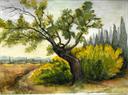
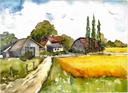
In 1984, Liselotte Baum retired and devoted herself with renewed energy to her passions, in particular painting and travel. Watercolour painting captivated her above all else. She favoured depicting landscapes, trees, and plants – subjects that reflected her lifelong bond with the natural world.
Through a painting group, she learnt the distinctive watercolour technique known as "Kung Ling" under the guidance of Chinese professor Wang Shu, further developing her artistic talents.
In 2009, a selection of her works was exhibited publicly at the "Galerie am Gesundbrunnen" of the Städtische Klinik Heilbronn.
Watercolour paintings by Liselotte Baum
Source: Private collection
2015
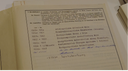
Career stations of Liselotte Baum in her personnel file
Source: Heilbronn City Archive
Farewell
After a long, fulfilling, and eventful life, Liselotte Baum passed away on 25 July 2015 at the age of 93 in Heilbronn.
Characteristic of her personality was the motto that her family chose to include in her obituary notice:
"Fight, strive, but live. Create, wrestle, but sing."
